
Building a React + Vite Sand/Water Sandbox

Introduction
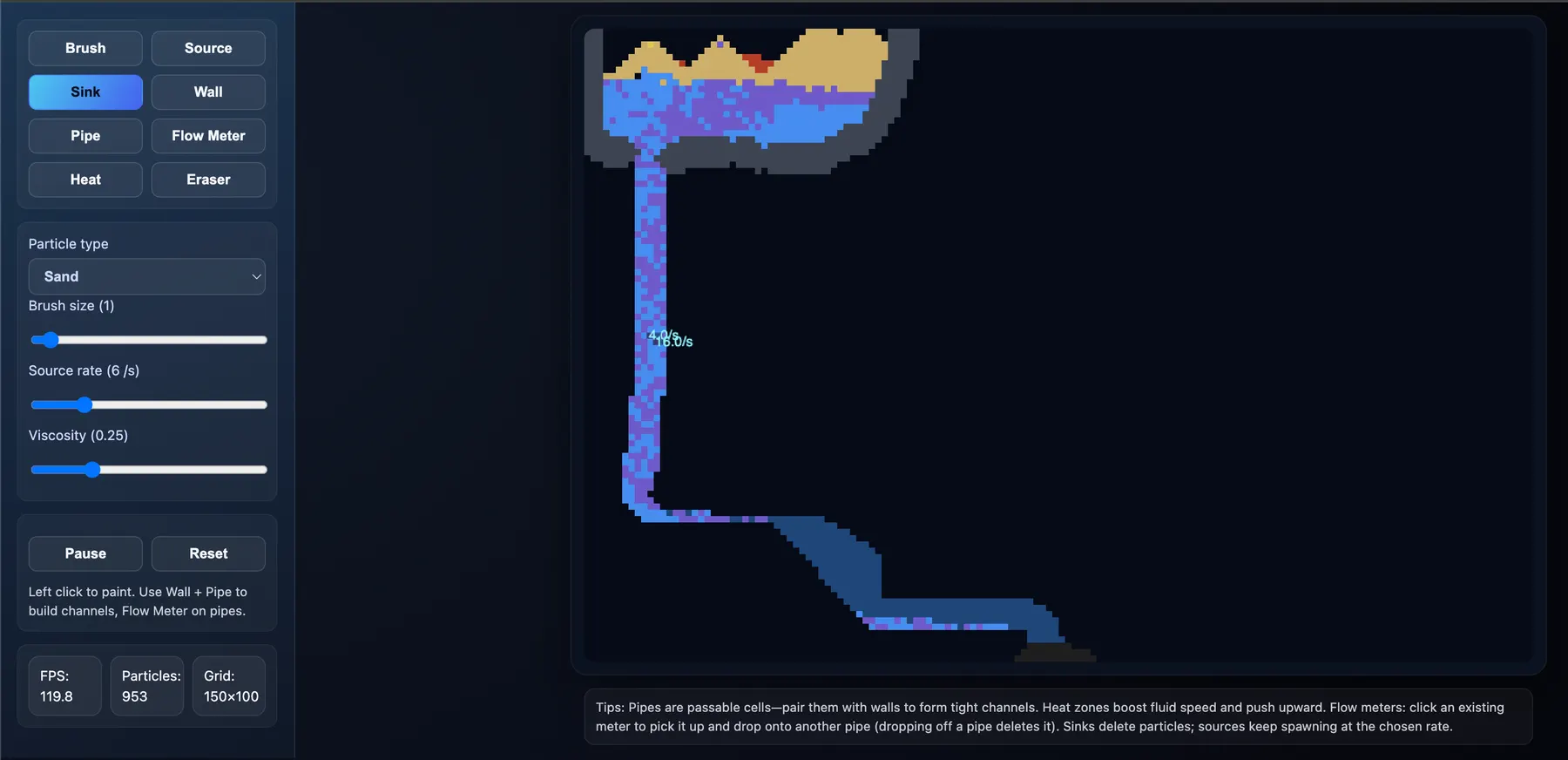
Particle sandboxes are a delightful intersection of physics intuition and playful experimentation. This one was built in roughly 30 minutes of 100% vibe coding—a fun pace for a toy, but not the process to copy for anything serious. It riffs on a flash game I remember playing during school breaks, now rebuilt with a React + Vite stack that runs entirely on an HTML canvas. A grid-based cellular update loop models sand piling, water flow, viscous drift, heat-driven pressure, and pipe-constrained transport. Tools like sources, sinks, walls, pipes, and moveable flow meters let you sketch small fluid circuits and observe emergent behaviors.
Implementation Details
Framework and rendering
Built with React + TypeScript (bundled by Vite), the simulation renders to a low-resolution canvas (150×100 grid, scaled up for a chunky pixel look). A pre-allocated ImageData buffer keeps per-frame work minimal before blitting to the visible canvas.
Simulation engine
- Grid + types: Each cell tracks a base tile (none, wall, pipe, source, sink, heat) and a particle (empty, sand, water, viscous). Temperature and simple velocity fields support heat/pressure effects.
- Update loop: A requestAnimationFrame loop advances the simulation. Sand falls straight down then diagonally; water/viscous flow downward with lateral slip controlled by a viscosity slider. Heated cells boost speed and add a small upward probability to mimic pressure.
- Sources & sinks: Sources accumulate fractional spawn amounts (
rate * dt) and emit the selected particle type. Sinks remove particles on contact. - Pipes: Once a particle enters a pipe, movement is constrained to pipe-friendly cells (pipe/source/sink/heat), keeping flow inside channels. Walls around pipes help shape proper conduits.
- Heat: Heat cells hold temperature at 1; surrounding cells cool over time. Higher temperature increases fluid mobility and upward push.
- Flow meters: A flow meter attached to a pipe cell counts particles passing through per second. Meters are moveable—click to pick up, click another pipe to drop, or drop off-pipe to remove.
Tooling and controls
- Tools: Brush (paint particles), Source, Sink, Wall, Pipe, Flow Meter, Heat, Eraser.
- Sliders: Brush size, source spawn rate (particles/sec), viscosity.
- Transport: Pipes act as guided channels; walls block; sinks drain. Heat accelerates and lifts fluids, making compact chambers build pressure-like behavior.
- Performance: The fixed grid and single pass per frame keep it responsive in the browser without external physics libs.
Build notes
- This was built in about half an hour of pure vibe coding—great for a playful sandbox, but not the best approach for a production-grade simulator.
- The quick iteration keeps the code approachable and easy to tweak if you want to add new particle types or tweak movement rules.
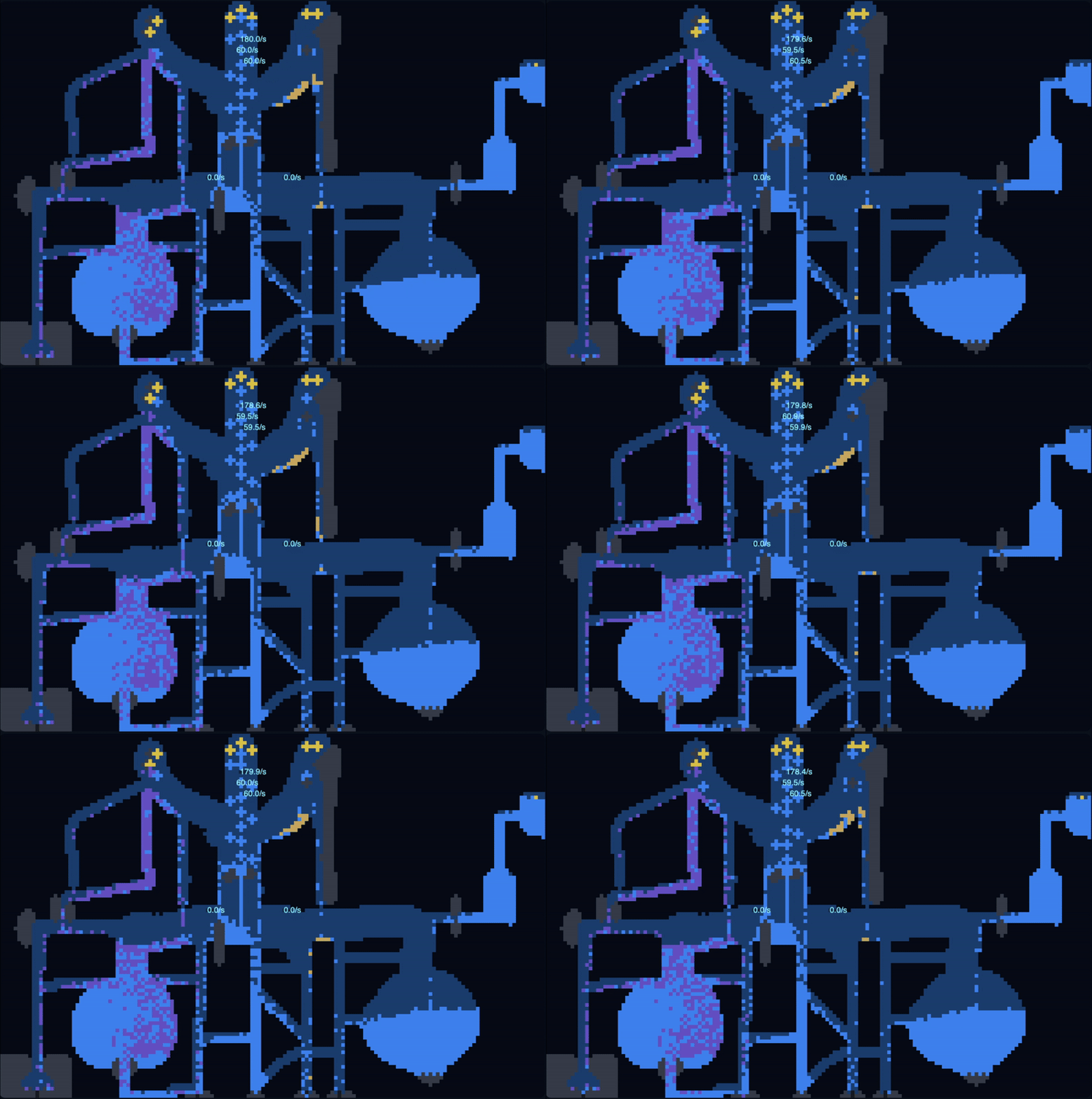
Screenshots
Conclusion
This React + Vite sandbox blends cellular automata simplicity with hands-on fluid play. Pipes, meters, and heat let you prototype tiny circuits—waterfalls, siphons, or pressure chambers—while the UI stays approachable. The vibe-coded, 30-minute build works for a small fun project; in a serious context, a more deliberate design, testing, and performance pass would be the better path.
See the code in this repo and run locally with npm install && npm run dev.
Source code: github.com/trolund/sand-box
Live demo: troelslund.dk/sand-box
References
- Canvas rendering optimizations: Mozilla Developer Network. (n.d.).
ImageDataand canvas 2D context.